

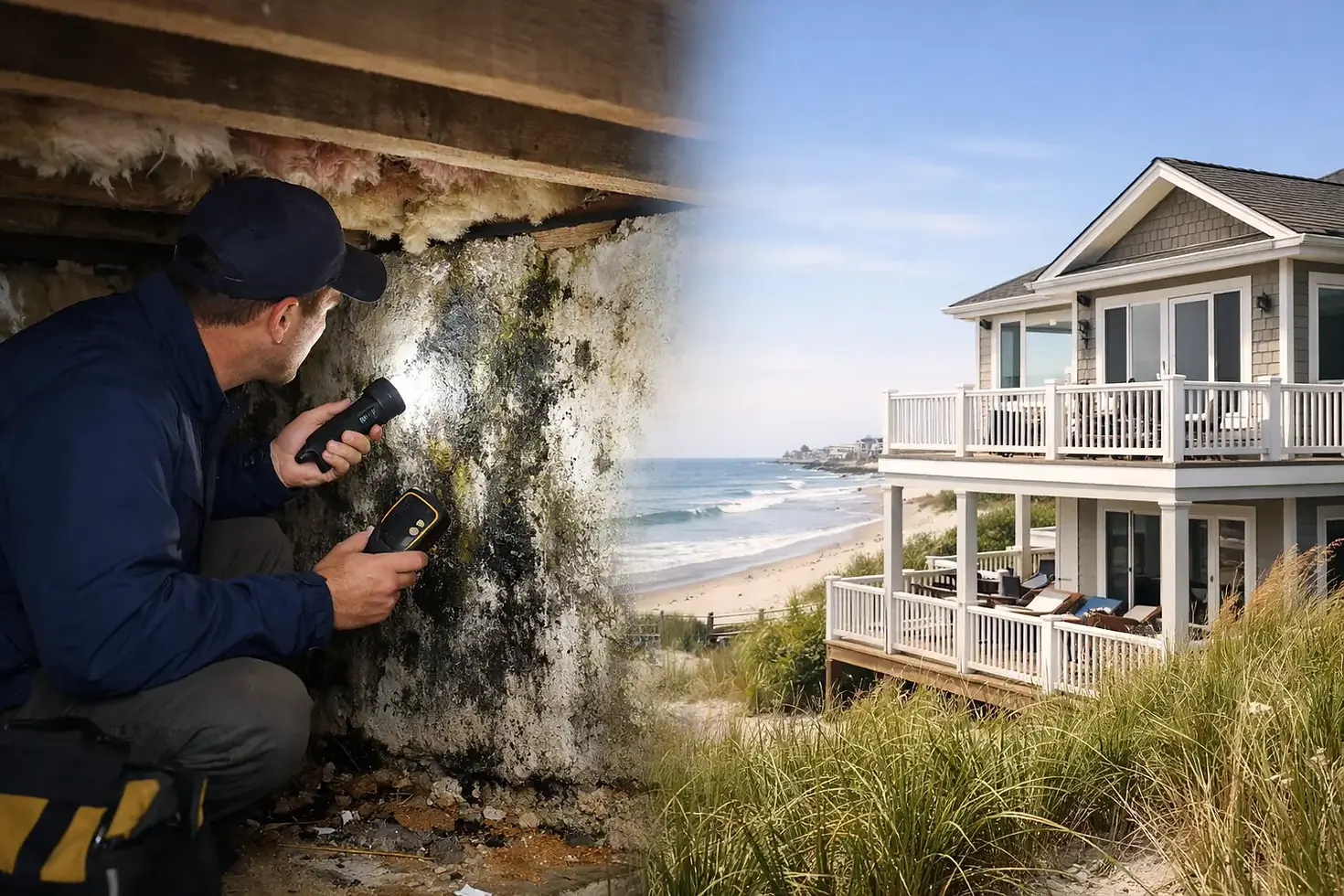
Mold Problems in Coastal New Jersey Properties
A house two blocks from the bay can look clean, smell fine, and still have a mold history hiding behind a finished wall, under vinyl flooring, or inside a crawl space. That is why mold problems in coastal New Jersey properties deserve a closer look during the inspection period, especially in homes with seasonal vacancy, past storm exposure, or older moisture-prone construction.
Along the South Jersey coast, mold is rarely a one-cause issue. What we usually see is a moisture pattern. High outdoor humidity, salt-air exposure, damp crawl spaces, condensation at ductwork, roof leaks that went unchecked, and homes sitting empty for stretches all work together. The visible growth is only part of the story. The bigger question is always why the conditions were right for it in the first place.
Why mold problems in coastal New Jersey properties are so common
Coastal homes deal with a different moisture load than inland properties. Even when a home has no active leak on the day of the inspection, the building may still be holding moisture in materials and enclosed spaces. In shore-area properties, that often shows up in attics, crawl spaces, utility closets, and around HVAC components.
Seasonal use adds another layer. A house that sits closed up for part of the year can trap humidity indoors for long periods. If the air conditioning is not managed properly, or if ventilation is poor, moisture builds up where air does not move well. We often find this in second homes, short-term rental properties, and homes that changed hands after long vacancy.
Construction style matters too. Raised homes, slab homes, older capes, and houses with additions each have their own weak points. A newer finish does not always mean the underlying moisture issue was corrected. Sometimes the cosmetic work is recent, but the staining, elevated moisture, or microbial growth pattern tells a different story.
Where inspectors commonly find mold-related issues
The places buyers worry about first are bathrooms and basements. Those matter, but in coastal South Jersey, we often pay just as much attention to the less obvious areas.
Crawl spaces and lower-level framing
Crawl spaces are one of the most common problem areas. Damp soil, missing or damaged vapor barriers, poor drainage conditions, and limited air movement can create ideal conditions for microbial growth on joists, subflooring, and insulation facings. In some properties, the issue is obvious. In others, the crawl space only shows elevated moisture, staining, or conditions that strongly support future growth.
A crawl space problem is not isolated to the crawl space. It can affect indoor air quality, flooring performance, and the overall moisture balance of the home. If the floor above feels uneven, smells musty, or has repeated cupping or movement, that lower area deserves careful attention.
Attics with poor ventilation or past roof leaks
Attics are another frequent trouble spot. Bathroom exhaust fans that terminate into the attic instead of the exterior can dump warm, humid air directly into a closed space. Add limited ventilation or a small roof leak, and mold-like growth can develop on roof sheathing and framing.
This is especially common in houses where the attic looks dry at first glance but has darkened sheathing near eaves, ridge areas, or around old repair points. The issue may be active, old, or somewhere in between. That distinction matters, because a corrected leak with past staining is different from current moisture intrusion.
HVAC closets, air handlers, and duct connections
Cooling systems can contribute more than people realize. Condensation at air handlers, blocked drain lines, poorly insulated ductwork, or air leakage near supply boots can introduce moisture into concealed spaces. In coastal conditions, the difference between normal humidity and a mold-supporting environment can be small.
When we inspect around HVAC equipment, we are not just looking for growth. We are looking for the source condition - standing water, rust, wet insulation, condensation marks, and signs that moisture has been recurring rather than incidental.
Windows, exterior walls, and finished surfaces
Window perimeters, sliding doors, and exterior wall cavities can also be problem areas, especially in homes with wind-driven rain exposure. Sometimes the only visible clue is fresh paint, patched trim, or slight discoloration at a baseboard. A thermal imaging scan or moisture meter reading can help identify whether there is a larger concealed issue worth further evaluation.
What buyers and agents should not overlook
Not every mold concern presents as obvious black spotting on a wall. In fact, some of the more meaningful findings are indirect. A musty odor in a closet, staining under an air vent, swollen trim, or repeated patching in the same area can be more important than a small visible spot on a bathroom ceiling.
In a real estate transaction, context matters. If a seller disclosure mentions a past leak, that does not automatically mean there is a current mold issue. But it does mean the affected areas should be evaluated closely for proper repair, residual moisture, and evidence of recurring conditions. The same is true after roof replacement, plumbing repairs, or storm-related restoration work.
Buyers should also be careful with heavily renovated shore properties. Many are updated attractively for resale or rental use, but fast cosmetic work can conceal moisture damage rather than resolve it. New flooring, new drywall, and new paint should prompt better questions, not automatic confidence.
Mold problems in coastal New Jersey properties are usually moisture problems first
This is the part that gets missed most often. Mold is the result, not the starting point. During an inspection, the goal is to identify signs of mold-like growth where visible and accessible, but also to document the conditions that support it. Without that, the conversation stays too shallow.
For example, if growth is present in a crawl space but the real driver is chronic moisture entry and poor vapor control, surface treatment alone will not solve much. If an attic shows suspected microbial growth but the cause is a bath fan venting indoors, the ventilation defect has to be addressed as part of the correction. If a wall cavity is damp because exterior flashing is failing, the wall finish is only part of the issue.
That is why a thorough inspection is valuable even when the concern starts with a simple question like, "Do you think this is mold?" The better question is, "What is allowing this condition to happen here?"
What a home inspection can realistically tell you
A standard home inspection can identify visible signs of moisture intrusion, staining, elevated moisture conditions, ventilation defects, and suspected mold-like growth in accessible areas. It can also help establish whether the pattern looks isolated or more widespread. That is often enough to help a buyer decide whether to move forward, request further evaluation, or renegotiate based on the property condition.
What it cannot do is see through every finished surface or confirm every concealed condition without additional testing or invasive access. That is where experience matters. An inspector who works coastal South Jersey properties regularly knows where these homes tend to hide moisture and which findings are minor versus worth taking seriously.
At Next Day Property Inspections, that practical distinction is a big part of the job. Buyers do not need alarm. They need a clear read on what was observed, what likely caused it, and what deserves follow-up before closing.
When mold concerns are more than a minor defect
Some findings are relatively limited and tied to a known source. Others suggest a larger property condition issue. Widespread staining, multiple affected areas, heavy musty odor, repeated moisture indications at exterior walls, deteriorated crawl space materials, or visible growth around HVAC components usually call for more attention than a small isolated patch in a bathroom.
The transaction timing matters too. If the home is occupied and climate-controlled, the inspection may reflect one set of conditions. If it has been vacant with the windows shut through a humid stretch, the moisture pattern may be worse than normal. Neither scenario should be ignored. They just need to be interpreted in context.
For investors and real estate professionals, that context helps with risk. A mold concern tied to a corrected plumbing leak is one thing. A property with multiple moisture pathways, poor ventilation, and signs of repeated concealed damage is a different level of project.
Coastal properties can be excellent homes and strong investments, but they need to be understood on their own terms. When a house near the shore shows signs of moisture, the right move is not to assume the worst or brush it off. It is to get a careful inspection, understand the pattern, and make decisions based on what the building is actually telling you.


